
Bagged plaster
Bagged plaster in 20-foot containers, shipped in campaigns spread over the year: in 2025, departures were staggered from January to September.
Plaster and casting fibresMWB TRADING has shipped regularly to the Republic of the Congo since 2023, from Sfax and, for solvents, from Radès (Tunis). Our containers delivered to the port of Pointe-Noire carry plaster, white cement and plaster adhesive, calcium carbonate and other raw materials for paint manufacturing, electrical conduit and PVC pipes, and waterproofing membranes, for distributors and manufacturers in the Republic of the Congo.
This guide sets out the verified points for importing into the Congo: the electronic cargo tracking note (BESC) required for each bill of lading, the PCEC certificate of conformity required before customs clearance, CEMAC rules on customs duties and payment, and what to state in your enquiry. Public reports show how our containers for Pointe-Noire were loaded.
Sources: 2008 order of the Ministry of Transport and Congolese Shippers’ Council (BESC, April 2025); GTAI (January 2024), TÜV Rheinland (July 2026) and Les Dépêches de Brazzaville (August 2026) for the PCEC; Logistics Cluster and Les Dépêches de Brazzaville (March and June 2026) for corridors and the single window; WTO Trade Policy Review of CEMAC (2023) and the 2018 CEMAC foreign exchange regulation; our export declarations and bills of lading since March 2023. Checked in October 2026; to be confirmed with your freight forwarder before each shipment.
MWB TRADING has shipped regularly to the Republic of the Congo since 2023, from Sfax and Radès (Tunis). These product families appear in our loads for Pointe-Noire; the catalogue pages detail the available references.
Bagged plaster in 20-foot containers, shipped in campaigns spread over the year: in 2025, departures were staggered from January to September.
Plaster and casting fibresBagged calcium carbonate, shipped in campaigns in 20-foot containers, with solvents, talc, iron oxides and other raw materials for paint manufacturing.
Calcium carbonate Raw materials for paintsBagged white cement and plaster adhesive, in 20-foot containers, loaded on their own or with plaster.
Corrugated conduit in coils and PVC pipes, loaded in Sfax in 40-foot High Cube containers; in 2025, departures in April, with PVC pipes, and in September.
ICTA corrugated conduit PVC pipes and fittingsBituminous membranes in rolls, shipped with plaster in February 2024.
Waterproofing membranesThese ranges complement our loads for Pointe-Noire. They are aimed at the same distributors and manufacturers and are available from Tunisia.
Building wires and cables in coils, power cables on drums, switches and sockets, to complement the ICTA conduit we already ship to Pointe-Noire. The PCEC programme requires equipment rated 220 or 230 V and 50 Hz, with French-type plugs and sockets.
Building wires and cables Electrical cables Electrical wiring devicesFloor tiles, wall tiles and porcelain stoneware, with tile adhesives and grouts, by the pallet or by the full container. Specify the formats, the use (floor or wall, indoor or outdoor) and the areas to be covered.
Floor and wall tiles Tile adhesivesPlastic buckets and boxes for packing paints, fillers and adhesives. Specify the capacities, colours and required printing.
Plastic packagingPPR pipes and fittings for plumbing and HDPE pipes for water networks, in lengths or coils depending on the diameter, to complement the PVC pipes we already ship.
PPR pipes and fittings HDPE pipes and fittingsOur public reports for Pointe-Noire show the products, their packaging and container loading.
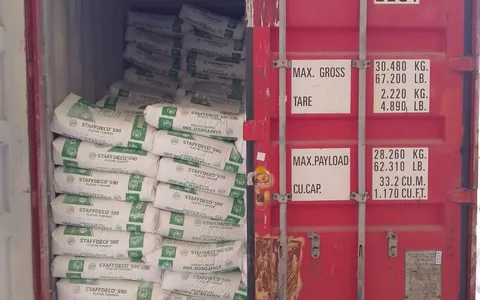
Bagged plaster for Pointe-Noire: shipments in January, May, July and September 2025. The report shows the January, July and September loadings.
View the report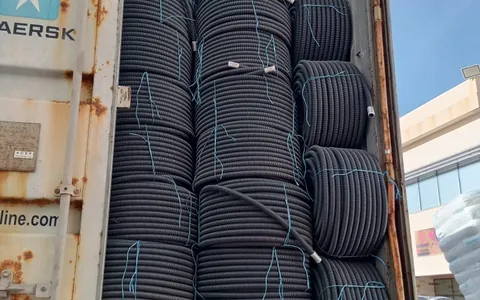
Corrugated electrical conduit coils and PVC pipes: shipped from Sfax to Pointe-Noire in April and September 2025.
View the report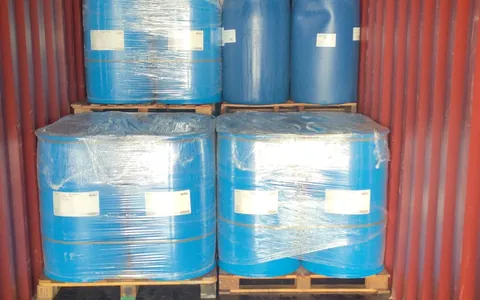
Solvents and paint raw materials in drums and bags: load prepared for Pointe-Noire in October 2024.
View the report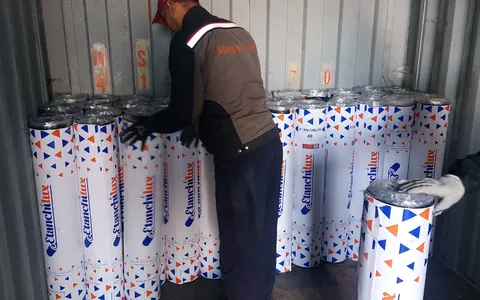
Plaster and bituminous membranes in rolls for Pointe-Noire: loaded in January and shipped in February 2024. The photographs show the membranes being loaded.
View the reportOur loads for the Congo leave from Sfax, and from Radès (Tunis) for solvents; they are delivered to the port of Pointe-Noire, the country’s only seaport, which is deep-water. Brazzaville is linked to Pointe-Noire by National Road 1 and by the Congo-Ocean Railway, which is being modernised. For Brazzaville or an inland site, state the final location: onward transport after the port is assessed separately.
Each bill of lading bound for the Congo, transit included, must be covered by an electronic cargo tracking note (BESC) issued for the Congolese Shippers’ Council. The carrier must check that it exists before loading and enter its number on the transport document; a customs declaration without a BESC is inadmissible, and late validation may incur additional fees. The commercial invoice, packing list and PCEC certificate of conformity complete the file; foreign trade formalities go through the cross-border operations single window (GUOT).
Since February 2024 (bill of lading date), goods imported into the Congo, unless exempt, must present at customs clearance a certificate of conformity under the Congolese conformity assessment programme (PCEC), overseen by the Congolese standards and quality agency (ACONOQ). Goods are verified before shipment by an approved provider, Cotecna or TÜV Rheinland in 2026, based on the invoice, test reports and data sheets; the procedure has been fully online since August 2026. Consignments whose value stays below a threshold set by the programme are exempt.
20-foot containers for plaster, white cement, adhesive, calcium carbonate and membranes; 40-foot High Cube for conduit and pipes, which are light but bulky, and for solvents and paint raw materials.
Plaster tonnage or number of bags and the preferred split by departure, conduit diameters and lengths, waterproofing references, technical and safety data sheets for raw materials, and the receiving location.
Availability, transport, lead times and documents are confirmed in each offer.
State your products, quantities and receiving location. The Republic of the Congo is already selected; you can change it.
Chat on WhatsAppYes: all cargo bound for the Congo, transit included, must be covered by a BESC, issued for each bill of lading for the Congolese Shippers’ Council. Without a BESC, the customs declaration is inadmissible and the goods may be held; validation requested too long after the vessel’s departure may incur additional fees.
Yes, unless exempt: since February 2024, the PCEC certificate of conformity must be presented before customs clearance. Goods are verified before shipment by a provider approved by ACONOQ; have the data sheets, test reports and, for raw materials, safety data sheets ready.
Customs duties follow the CEMAC common external tariff, which applies to goods from non-member countries, including Tunisia. Payment falls under the CEMAC foreign exchange regulation: above a threshold set by the 2018 regulation, the import is domiciled with a bank in the Congo, and the import declaration refers to the pro forma invoice.
Yes. In 2025, our plaster departures for Pointe-Noire were staggered from January to September. The schedule for each lot is agreed with you in the offer.
Our shipments arrive at the port of Pointe-Noire. For Brazzaville, which is linked by National Road 1 and the Congo-Ocean Railway, state the receiving location: onward transport after the port is assessed with its conditions.
Solvents and some raw materials are subject to specific transport rules: classification, packaging and labelling. Attach their safety data sheets; they determine the loading conditions and whether goods can be grouped. Our solvents and paint raw materials have thus travelled by 40-foot High Cube container.
Let’s talk on WhatsApp: send us your product references, purchasing list or project details.